
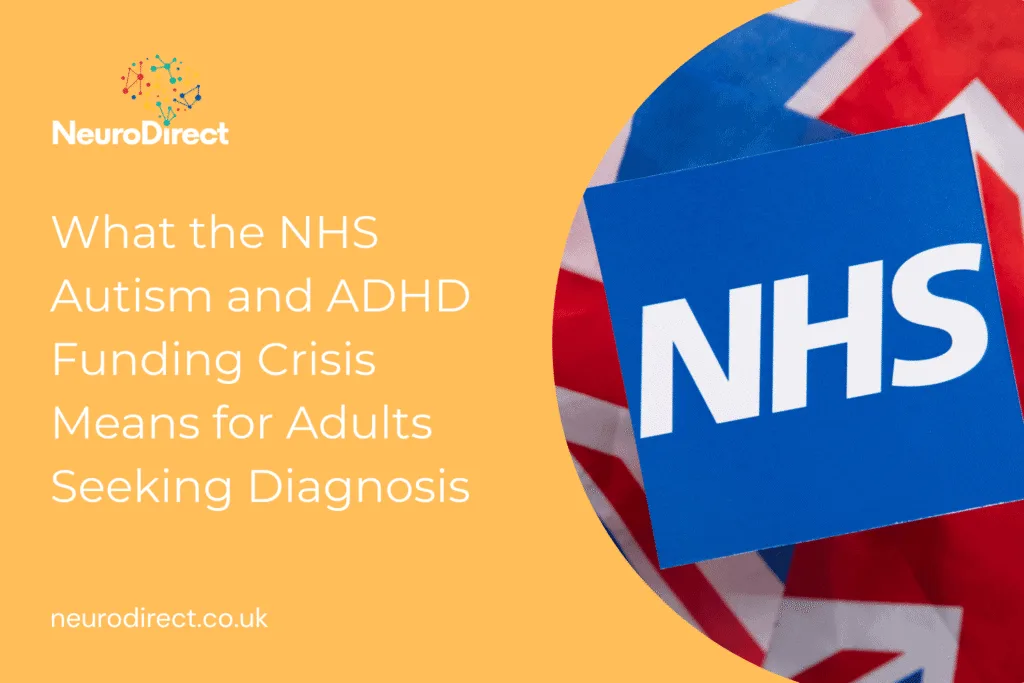
The BBC reported today that NHS bosses are warning autism and ADHD care is at risk of collapsing into chaos. Costs are spiralling, unregulated private providers are expanding rapidly to meet demand, and there’s huge variation in what different patients are being charged for essentially the same assessment. In one striking example, a local health board saw its annual spend jump from £4 million to £30 million in just two years.
If you’re someone who suspects you might be autistic and haven’t yet pursued a diagnosis, headlines like this can feel discouraging — or just confusing. What does a funding crisis in NHS commissioning actually mean for you, practically speaking?
The NHS Alliance, which represents health service managers, described the current setup as a “bad deal” for patients and taxpayers. Long NHS waiting lists pushed many boards to lean heavily on outside providers, and that expansion outpaced the system’s ability to check who those providers are and what they charge — one board reported working with 48 different providers, four times as many as two years earlier. What this confirms is worth knowing early: you generally don’t have to wait on an NHS list, and you don’t have to go private out of pocket either.
What the NHS autism and ADHD funding crisis changes for you
Right to Choose: the option most people don’t know they have
Under the NHS’s Right to Choose policy, if your GP refers you for an autism or ADHD assessment, you’re entitled to ask to be seen by an approved non-NHS provider instead of joining your local waiting list — at no extra cost to you, funded the same way an NHS appointment would be. This is precisely the mechanism the BBC piece is describing: it’s why non-NHS providers have expanded so quickly. If your GP says the local wait is long, you can ask them directly about a Right to Choose referral to a specific provider. It doesn’t cost more, but it does mean the choice of provider matters.
Why provider variation actually matters to you
This is where the BBC’s reporting is genuinely useful for anyone about to make that choice. The huge swings in what boards are being charged — one paid anywhere from £300 to £3,000 for broadly similar assessments — reflect a market with guide prices but no enforced standard, and a rapid influx of providers that boards are struggling to vet for quality and safety. Providers that only carry out assessments, rather than ongoing treatment, don’t even need to be registered with the Care Quality Commission.
That doesn’t mean every non-NHS provider is a poor choice — many are excellent, and Right to Choose exists precisely because it’s helped cut some of the worst waiting times. But it does mean you shouldn’t assume all providers are equivalent. Before committing to one, check their clinical credentials, how they conduct assessments, what’s included in the price, and whether other patients rate them well.
The scale of demand behind this crisis is real
Over the past year, more than 100,000 adults have taken NeuroDirect’s free RAADS-R screening test — one of the most widely used research-validated autism screening tools. That’s a meaningful signal of just how many adults are quietly asking themselves the same question you might be asking right now, often for years before doing anything about it. The funding crisis being reported today is, in large part, downstream of exactly this: a huge and growing number of adults recognising traits in themselves and looking for a way to get properly assessed.
What to actually do next
None of the system-level chaos changes the value of understanding your own starting point before you spend any money or commit to a provider.
- Take the free RAADS-R screening test — a validated, research-based tool that gives you a clearer picture of where you sit.
- Read more on our free autism test page if you’re not sure which screening approach fits you.
- Browse our specialist directory before choosing a provider, so you’re comparing credentials and approach rather than guessing.
Understanding your own results, and knowing your options — NHS, Right to Choose, or private — puts you back in control of a system that, right now, is genuinely difficult for anyone to navigate blind.
Frequently Asked Questions
What is Right to Choose for autism and ADHD assessment?
Right to Choose is an NHS policy that lets patients ask their GP for a referral to an approved non-NHS provider for autism or ADHD assessment, instead of joining the local NHS waiting list. It’s funded the same way an NHS referral would be, at no extra cost to the patient.
Why do private autism assessment providers charge such different prices?
Unlike routine NHS procedures, autism and ADHD assessments don’t have a fixed national tariff — only guide prices that providers aren’t required to follow. This has led to wide variation in cost and, in some cases, in quality and regulatory oversight between providers.
Do I need a diagnosis to know if I’m autistic?
A formal diagnosis requires clinical assessment, but validated self-report screening tools like the RAADS-R can help you understand whether your traits are consistent with an autistic profile before deciding whether to pursue formal assessment.

 ADHD
ADHD